Learn · Agent loops & runtime access
Why agent loops need runtime access control
Last updated:
In short
Agent runtime access control is the policy layer that decides whether an AI agent may use a credential for a specific workspace, service, host, and action — without exposing the raw secret.
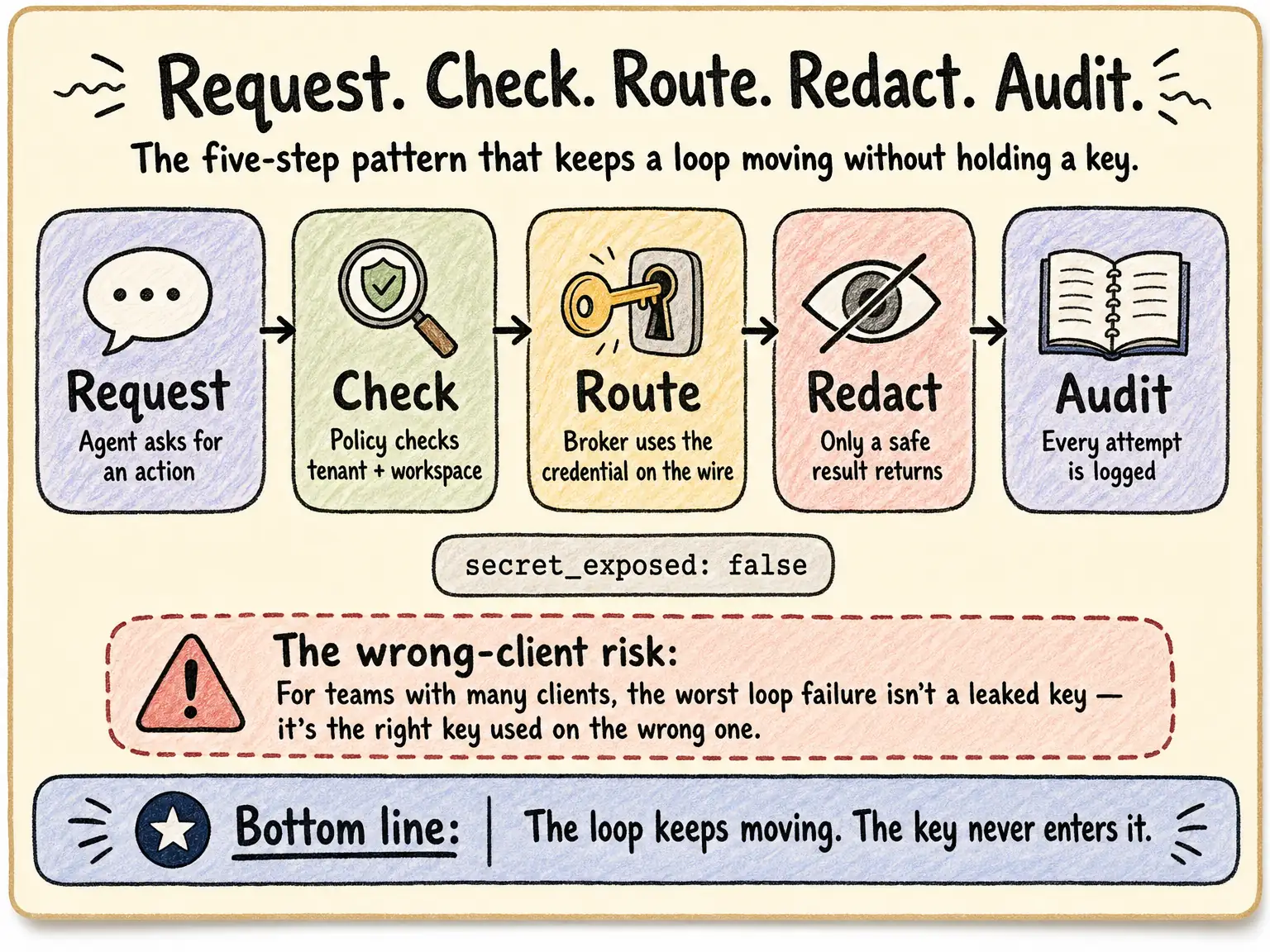
As AI agents move from one-shot prompts to loops that call tools and APIs repeatedly, that access becomes the security boundary. The safe pattern: the agent requests an approved action, policy checks the workspace, a local broker performs the call, and only a redacted result returns — so the loop keeps moving without ever holding a raw key.
Coding agents used to answer one prompt at a time. Increasingly they run in loops: they take a goal, act, check the result, fix, and go again — often for many iterations with no human watching each step. That is powerful. It also quietly changes the risk model around API access, because a loop uses real credentials against real systems, over and over.
Agent loops are not just prompts
A one-shot prompt does a thing once and stops. A loop has a trigger, a goal, and an evaluation step, and it repeats until the goal is met or it gives up. Between iterations it reads files, runs commands, calls tools, and inspects output. The agent is no longer a single request you supervise — it is an autonomous worker that needs to reach systems on its own.
Loops need real access to real systems
To make progress, the loop has to call APIs — a CRM, email, billing, an automation platform, a
client's account. Each call needs a credential. The naïve answer is to hand the loop a key (paste
it, drop it in .env, read it from a
vault). The moment you do, the autonomous loop is holding a raw secret it will use again and again.
The risk of raw API keys inside loops
One prompt with a key is risky. A loop with a key is riskier, because exposure scales with iterations:
- •Repeated calls mean repeated chances for the key to surface in chat, logs, or stdout.
- •Generated code and artifacts can embed the secret without anyone noticing.
- •A loop runs unattended, so a leak can happen with no human in the room to catch it.
More on this in why .env files break down for agents.
The wrong-client problem
For teams running agents across many clients, the worst loop failure is not a leaked key — it is the right key used on the wrong client. A copied skill still points at the previous tenant; a shared account blurs the boundary; an unattended loop writes to the wrong account before anyone notices. The blast radius is a real client's data.
Why vaults alone are not enough
Keep your vault — 1Password, Infisical, Doppler, Keychain are the right place to store secrets. But a vault's job is to return the secret value to the caller. In a loop, the caller is the autonomous agent, so the vault hands the key straight into the process you were trying to protect. Storage was never the gap; runtime use is.
The safe pattern: request, check, route, redact, audit
Instead of giving the loop a key, give it an approved-access path. The agent requests an action; the access layer decides and performs it; the loop gets back only a redacted result.
How a loop gets approved access without holding the key
- 01
Agent request
The agent asks for an approved action or alias — not a raw key.
- 02
Policy & tenant check
Outloop checks project, tenant identity, and runtime policy before anything runs.
- 03
Local broker
On approval, the local broker uses the credential on the wire to perform the call.
- 04
Redacted result
The agent receives a sanitized, non-secret result. Raw values never enter its context.
- 05
Audit log
Every attempt is written to a redacted local audit — decision, tenant, service.
The agent never sees the credential. A wrong-tenant request is denied at the policy check, before any backend call.
Where Outloop fits
Outloop does not build the loop. Outloop controls how the loop gets approved runtime access to APIs, tools, and client workspaces — without seeing raw secrets or touching the wrong client account. Secrets stay local in your existing backend; agents request actions, not keys; wrong-tenant calls are blocked by policy; and every attempt is written to a redacted local audit. For multi-client teams specifically, see Outloop for AI agencies.
Outloop is available with guided onboarding for agency teams; the Mac app is signed with a Developer ID and notarized by Apple, and release v1.1.6 was verified on two Macs on 24 July 2026. See the security model or pricing.
Agents should keep working. Humans should stop pasting keys.
Outloop is available with guided onboarding for AI agencies, operators, and dev shops.
Start 14-day trial