Compare
Outloop is not a vault
Last updated:
In short
An agent access router sits above your vault and controls how AI agents use secrets at runtime.
A vault stores and encrypts secrets. Outloop is an agent access router: it lets an AI agent request an approved action instead of a raw key, blocks wrong-tenant calls by policy, performs the call locally, and returns a redacted result — so the agent never sees the secret.
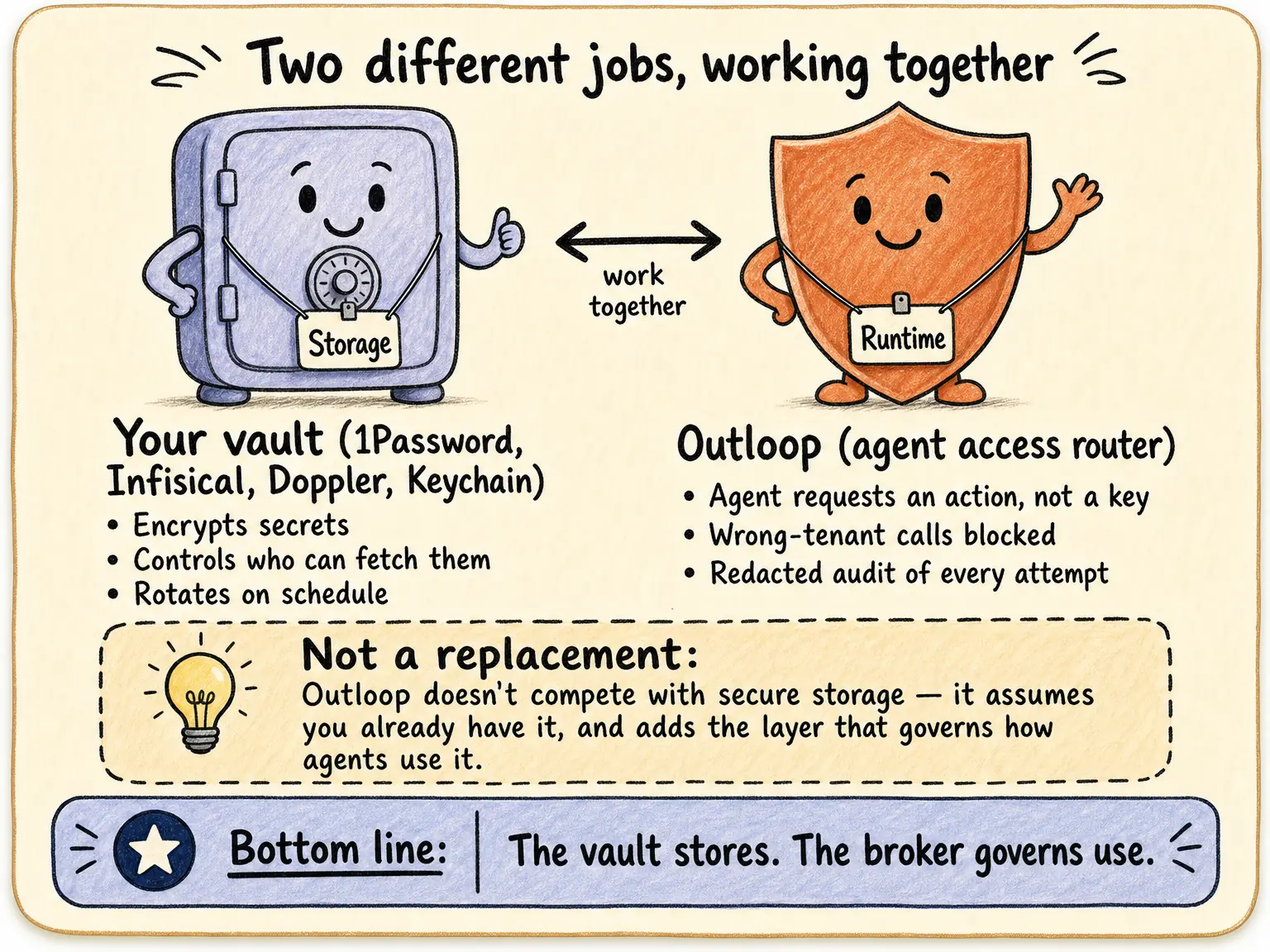
Vaults like 1Password, Infisical, and Doppler solve storage: they keep secrets encrypted at rest and rotate them. That is essential — and Outloop assumes you already have it. The gap they don't cover is runtime: what happens the moment an AI agent needs to actually use a credential across client workspaces.
That's the layer Outloop adds. Agents request actions, not raw keys; wrong-tenant access is blocked by policy; and every attempt is written to a redacted local audit. In industry writing this layer is increasingly called a credential broker for AI agents — the vault stores; the broker governs use.
Credential broker vs secrets vault
A secrets vault stores and manages secrets — it encrypts them at rest, controls who can fetch them, and rotates them on a schedule. A credential broker controls something different: runtime use. It decides whether an agent may use a given credential, here, now, for this action, and applies it without ever handing over the value.
Outloop sits above the secure backend as the broker layer — macOS Keychain today; 1Password, Infisical and Doppler integrations are not supported yet. It does not compete with secure secret storage — it assumes you already have it — and a vault and a broker are normally used together, not as alternatives to each other.
Vault vs. agent access router
| Capability | Vault (1Password · Infisical · Doppler) | Outloop (agent access router) |
|---|---|---|
| Stores & encrypts secrets | ✓ Built for this | Uses your vault — stores nothing |
| Agent receives the raw key | Yes, if you share it | No — the agent requests an action |
| Per-tenant runtime policy | — | ✓ |
| Wrong-client call blocked at runtime | — | ✓ |
| Redacted audit of agent use | — | ✓ |
| Where it runs | Your chosen backend | Local-first broker on your machine |
How a request actually flows
- 01
Client task
Start with the intended client and a defined result.
- 02
Approved Workspace
Use this client’s Context, accounts and resources.
- 03
Supported action
Work through the approved API, browser or file path.
- 04
Reviewable result
Inspect the output and involve a person where required.
- 05
Work history
Keep the work record with the intended Workspace.
Conceptual workflow. Supported actions depend on the configured service, runtime and approved resources.
Outloop is available with setup guides and product support for agency teams. It is built around local-first secret protection, tenant separation, and redacted audit — not a finished compliance certification. See the security model for what is and isn't proven yet, or how Outloop works above 1Password, Infisical, and Doppler.
Keep your vault. Put it to work safely.
Outloop is available with setup guides and product support for AI agencies, operators, and dev shops.
Start 14-day trial