Learn
Why "just use a secrets manager" isn't enough for AI agents
Last updated:
In short
A secrets manager protects how secrets are stored — then it returns the secret value to whatever asks for it.
With AI agents, the caller is the process you are trying to protect: it can read files, write logs, and echo to chat. So a vault solves storage but not runtime use. The fix is a layer above the vault that performs the approved action itself and returns a redacted result — the secret value never reaches the agent.
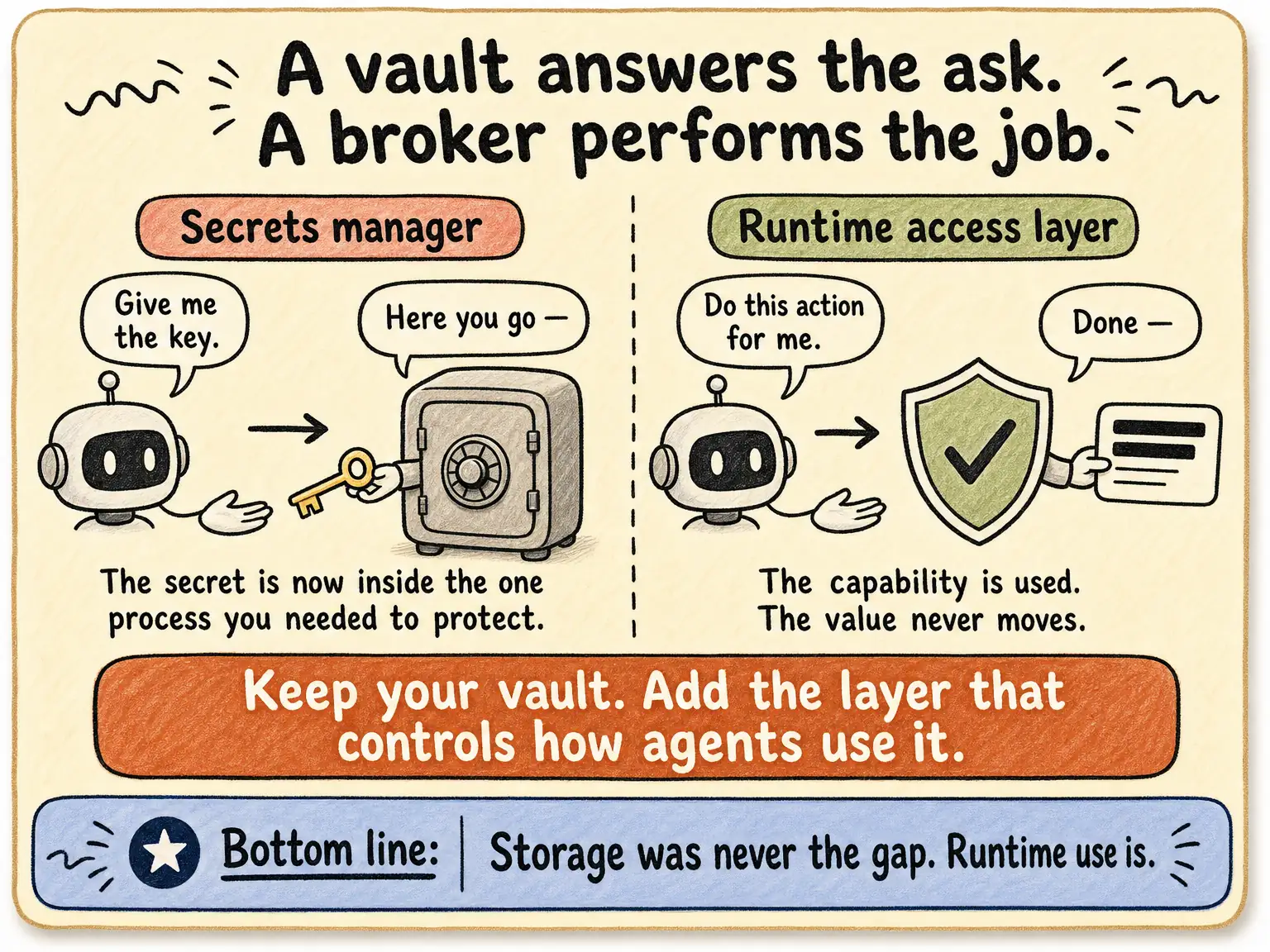
It is the standard advice, and it is half right: use a secrets manager. Tools like 1Password, HashiCorp Vault, Infisical, and Doppler are excellent at what they do — encrypt secrets at rest, control who can fetch them, and rotate them. You should use one.
But notice what a vault actually does when asked: it returns the secret value to the caller. That is the whole job. And that is exactly where AI agents break the model.
The caller is the compromised process
A traditional secrets manager assumes the thing fetching the secret is trustworthy and will use it carefully. With agents that assumption no longer holds. The caller is an autonomous agent that can read files, run shell commands, write logs, generate code, and echo output back into chat. The moment the vault hands the value over, the secret is inside the one process you most needed to keep it away from.
Storage was never the weak point. Runtime use is.
Credential broker vs secrets vault
A secrets vault protects and stores credentials — encryption at rest, access control, rotation. A credential broker controls how approved credentials are used at runtime — whether an agent may use a given credential, here, now, for this action, without the raw value ever reaching it.
Outloop does not replace a vault. It can sit above a secure credential backend and enforce workspace, account, host, action, and audit policy at the moment of use — the vault and the broker are complementary layers, not alternatives.
Storage layer vs. runtime access layer
| Capability | Secrets manager (storage) | Runtime access layer |
|---|---|---|
| Stores & encrypts secrets | ✓ Built for this | Uses your vault — stores nothing |
| Rotates secrets | ✓ | Inherits the vault's rotation |
| What the agent receives | The raw secret value | A redacted, non-secret result |
| Per-tenant runtime policy | — | ✓ |
| Wrong-client call blocked at runtime | — | ✓ |
| Redacted audit of agent use | — | ✓ |
What "control runtime use" actually means
Instead of fetching a secret and handing it to the agent, the access layer performs the action on the agent's behalf. The agent requests an approved action; the layer checks tenant and policy, uses the credential on the wire, and returns only a redacted result. The capability is used. The value never moves.
Using the credential without returning it to the caller
- 01
Agent request
The agent asks for an approved action or alias — not a raw key.
- 02
Policy & tenant check
Outloop checks project, tenant identity, and runtime policy before anything runs.
- 03
Local broker
On approval, the local broker uses the credential on the wire to perform the call.
- 04
Redacted result
The agent receives a sanitized, non-secret result. Raw values never enter its context.
- 05
Audit log
Every attempt is written to a redacted local audit — decision, tenant, service.
The agent never sees the credential. A wrong-tenant request is denied at the policy check, before any backend call.
This is also why teams keep building small internal proxies: they have a perfectly good vault and still need something that lets agents use a credential at runtime without ever receiving it. A runtime access layer is the durable, tenant-aware version of that pattern — increasingly called a credential broker for AI agents.
A wave of enterprise identity vendors now addresses agent credentials too — machine-identity and workload-identity platforms built for security teams running cloud infrastructure. Useful in that world, but it answers a different question. For operators running agents across client workspaces the line stays simple: the vault stores the secret; the broker governs its use at runtime.
Outloop is complementary to your vault, not a replacement — see how it differs from a vault and how it works above 1Password, Infisical, and Doppler. It is available with guided onboarding for agency teams; the Mac app is signed with a Developer ID and notarized by Apple, and release v1.1.6 was verified on two Macs on 24 July 2026. Read the full guide to AI agent API key management, or why this gap gets sharper in agent loops.
Keep your vault. Add the runtime layer.
Outloop is available with guided onboarding for AI agencies, operators, and dev shops.
Start 14-day trial