Learn · Agent loops & runtime access
How to keep humans out of agent loops without exposing API keys
Last updated:
In short
Human-out-of-the-loop automation breaks the moment an agent loop needs an API key and stops to ask a human to paste one.
The fix is to change what the loop asks for: an approved action, not a credential. A local broker checks policy, performs the call, and returns a redacted result — so the human leaves the runtime loop and the raw key never enters it. The agent keeps moving; you stop being the credential desk.
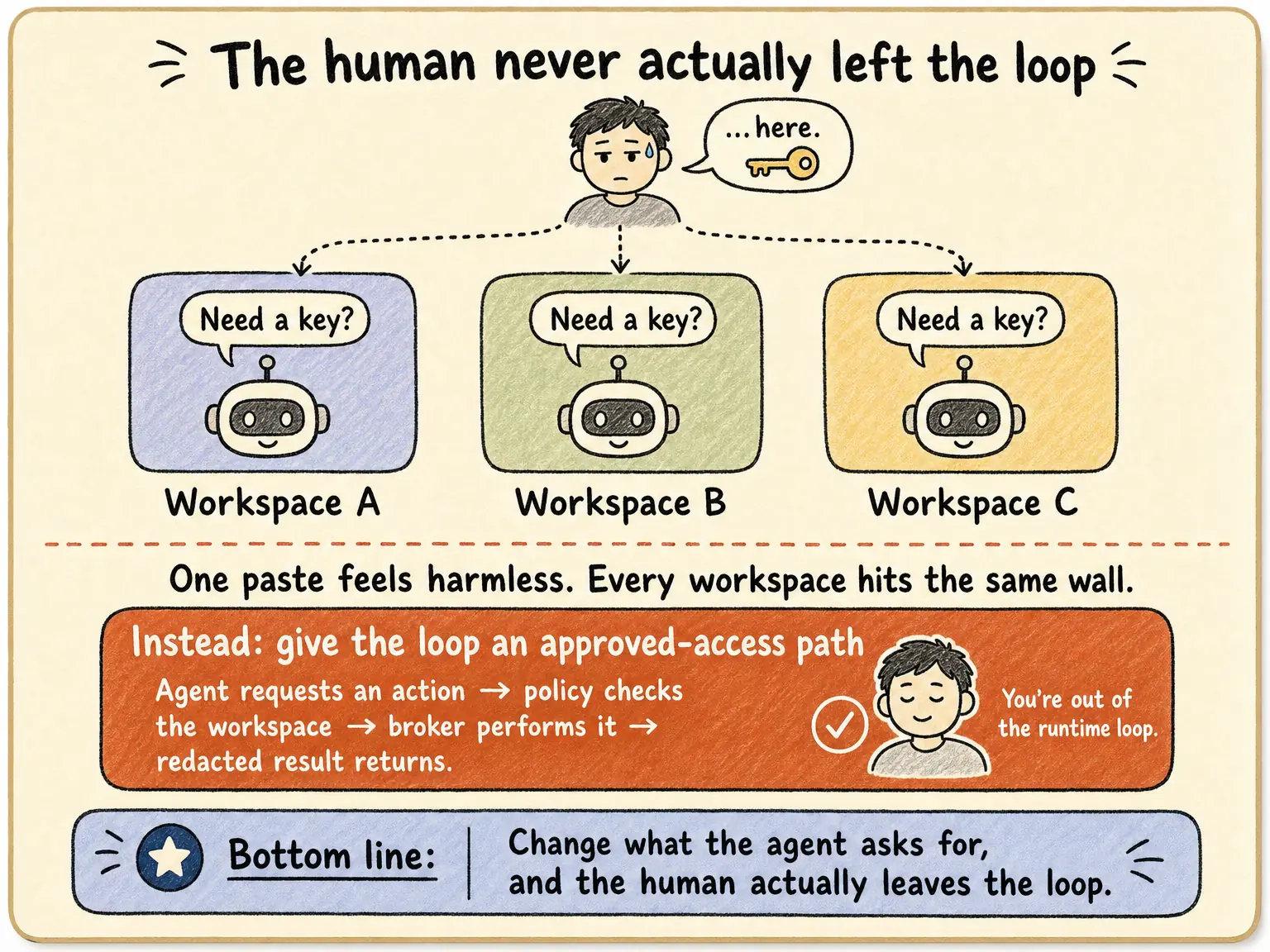
The real loop: agent asks, human pastes, secret spreads
"Human out of the loop" is the promise of agent automation. The reality often looks like this: the
agent gets going, hits a step that needs API access, and stops. It asks a human. The human pastes a
key. The loop resumes — and now the secret lives in the chat, maybe in a
.env, maybe in a log. Next workspace, next
skill, same thing. The human never actually left the loop.
Why pasting keys does not scale
One paste feels harmless. But agents work across many clients, skills, and scheduled tasks, and a loop reuses access on every iteration. Pasting keys turns the operator into a full-time runtime credential desk, and each pasted key is another copy to secure and rotate. See credential sprawl across workspaces.
Why .env isn't the escape hatch — and loops make it worse
The usual workaround — drop the key in .env
so the agent stops asking — just moves the raw secret into the workspace the agent can read, run, and
log from. In a loop, that exposure repeats on every pass.
Why .env files break down for agents.
What safe runtime access looks like
Keep the human out by giving the loop an approved-access path instead of a key:
The loop requests an action; the broker performs it
- 01
Agent request
The agent asks for an approved action or alias — not a raw key.
- 02
Policy & tenant check
Outloop checks project, tenant identity, and runtime policy before anything runs.
- 03
Local broker
On approval, the local broker uses the credential on the wire to perform the call.
- 04
Redacted result
The agent receives a sanitized, non-secret result. Raw values never enter its context.
- 05
Audit log
Every attempt is written to a redacted local audit — decision, tenant, service.
The agent never sees the credential. A wrong-tenant request is denied at the policy check, before any backend call.
How Outloop removes the human without exposing the key
With Outloop, the agent requests an approved action; policy checks the workspace and tenant; the local broker uses the credential on the wire and returns a redacted result; and a denial returns a clear code with a safe next step. Secrets stay local, wrong-client calls are blocked, and the operator is out of the runtime loop — which is the whole point. The broader pattern: why agent loops need runtime access control.
Outloop is available with guided onboarding for agency teams; the Mac app is signed with a Developer ID and notarized by Apple, and release v1.1.6 was verified on two Macs on 24 July 2026. See the security model.
Agents should keep working. Humans should stop pasting keys.
Outloop is available with guided onboarding for AI agencies, operators, and dev shops.
Start 14-day trial