Learn · Agent loops & runtime access
What is loop engineering, and who holds the API access when agents run without you?
Last updated:
When you stop prompting agents and start running loops, you also stop being the safety check on every API call. Outloop is the runtime access layer that keeps credentials, clients, and audit under control.
In short
Loop engineering is the practice of designing AI agent workflows that iterate toward a goal — trigger, act, evaluate, repeat — instead of answering a single prompt once.
As coding and operations agents move from prompts to loops, the design problem shifts from the perfect prompt to the cycle itself: what starts it, what goal it pursues, how it checks progress, and when it stops. Loops call real tools and APIs repeatedly — which is exactly why they need runtime access control.
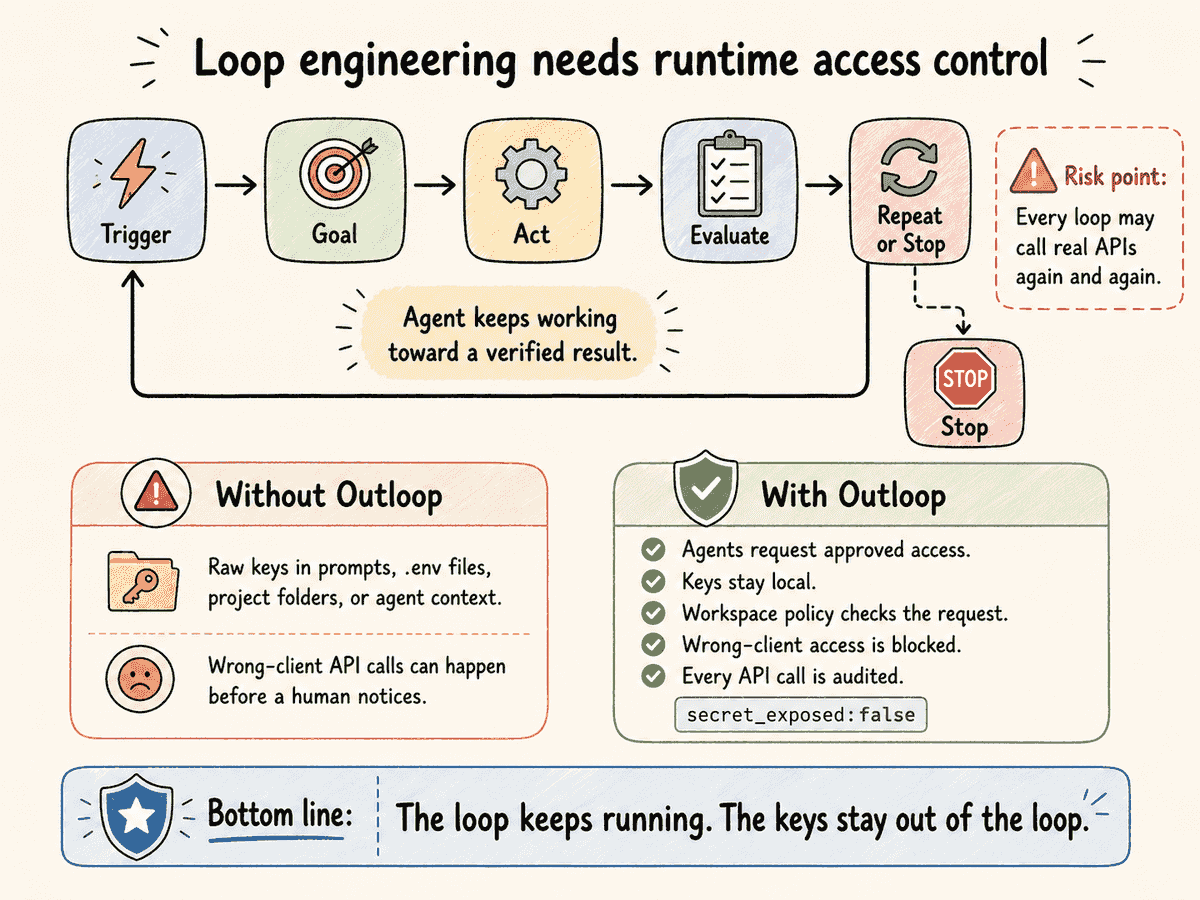
The term shows up wherever people build agents that keep working on their own. It is a useful way to name a real shift — and it is worth explaining plainly, without hype.
From prompts to loops
Prompt engineering optimizes one exchange: a good instruction in, a good answer out. Loop engineering optimizes the cycle. The agent takes a goal, acts, checks the result against the goal, and either keeps going or stops — closer to designing a worker's process than writing a single message. The most advanced teams now design the loop that prompts the agent, rather than prompting the agent themselves.
Trigger, goal, evaluation
A loop needs an event that starts it and a verifiable end state that tells it to stop. Triggers come in three forms:
- →Action-based — a specific event starts the run, like opening a pull request.
- →Scheduled — a recurring "cron" timeframe: every few minutes, daily, or weekly.
- →Human-initiated — a developer writes a full spec, starts the run, and steps back.
Goals split by how the agent verifies success. A deterministic goal is checkable by machine — tests pass, CI turns green, a function runs without error. A non-deterministic goal asks the model to judge completeness against a written spec, which is harder, because it asks the agent to evaluate taste.
Loop vs. automation
A standard automation is linear — a fixed series of steps runs start to finish. A loop has an internal decision step: it evaluates its own output against the goal and decides whether to iterate again or stop. That self-evaluation is the whole point — and it changes where the risk sits, because the system, not a person, decides whether to call the API again.
Designing a loop that holds up
- →Define the trigger precisely — a task, a schedule, or an event.
- →Write the goal as a checkable state, not a vibe — the evaluation step needs something concrete to test against.
- →Build the evaluation and stopping condition first — a loop with no stop is how runaway cost and wrong-account actions happen.
- →Give the loop scoped access, not raw keys — every iteration is another chance to leak a secret.
- →Keep an audit trail — when a loop runs unattended, you need to know what it did, on which account, after the fact.
Why loops need tools, API access — and control
A loop that can't touch real systems can't make real progress. So loops call APIs — a CRM, email, billing, a client's account — repeatedly. That is where the risk concentrates: secrets become riskier inside loops because every iteration is another chance to leak, and an unattended loop can act on the wrong account before anyone notices. The deeper dive: why API keys become more dangerous in loops and why agent loops need runtime access control.
Where this is heading
Today, this is still early and expensive — running agents in long loops burns a lot of tokens — but the pattern is spreading. As it moves from a handful of labs toward the agencies, operators, and dev shops running agents across real client accounts, the access problem spreads with it. And AI agencies won't run just one loop — they'll run loops across many clients. That's where wrong-client API access becomes the real risk.
A concrete loop
An agency runs an agent nightly to sync each client's leads into their CRM. The trigger is the nightly schedule; the goal is "the CRM matches the lead source"; the evaluation is "row counts reconcile." The catch is the access: the loop calls every client's CRM API, every night — dozens of keys across dozens of accounts. That access-and-secret problem is the slice a runtime access layer handles. See Outloop for AI agencies.
Where Outloop fits
When you stop prompting agents and start running loops, you also stop being the safety check on every API call. The more autonomous the agent and the more iterations it runs, the more credential and wrong-client risk concentrates.
Outloop does not build the loop and is not a loop-engineering platform. It is the runtime access layer for the access, secret, and audit slice of a loop — not the loop logic itself. Outloop keeps API access out of the loop. Keys stay local. Agents get approved access, not secrets. Concretely:
- →Approved access, not raw keys — the agent requests an action; the local broker attaches the credential host-side without exposing it to the agent.
- →Tenant separation — a multi-client loop can't act on the wrong client's account.
- →An audit log of every brokered action — so an unattended loop is reviewable, not a black box.
So the loop you engineered keeps running safely.
Outloop is available with guided onboarding for agency teams; the Mac app is signed with a Developer ID and notarized by Apple, and release v1.1.6 was verified on two Macs on 24 July 2026.
Keep the loop running — without you in it.
Outloop is available with guided onboarding for AI agencies, operators, and dev shops.
Start 14-day trial