Learn · Multi-client operations
The hidden risk in autonomous agent loops: wrong-client access
Last updated:
In short
Wrong-client access is when an AI agent uses valid, authorized credentials on the wrong client — the right key pointed at the wrong tenant.
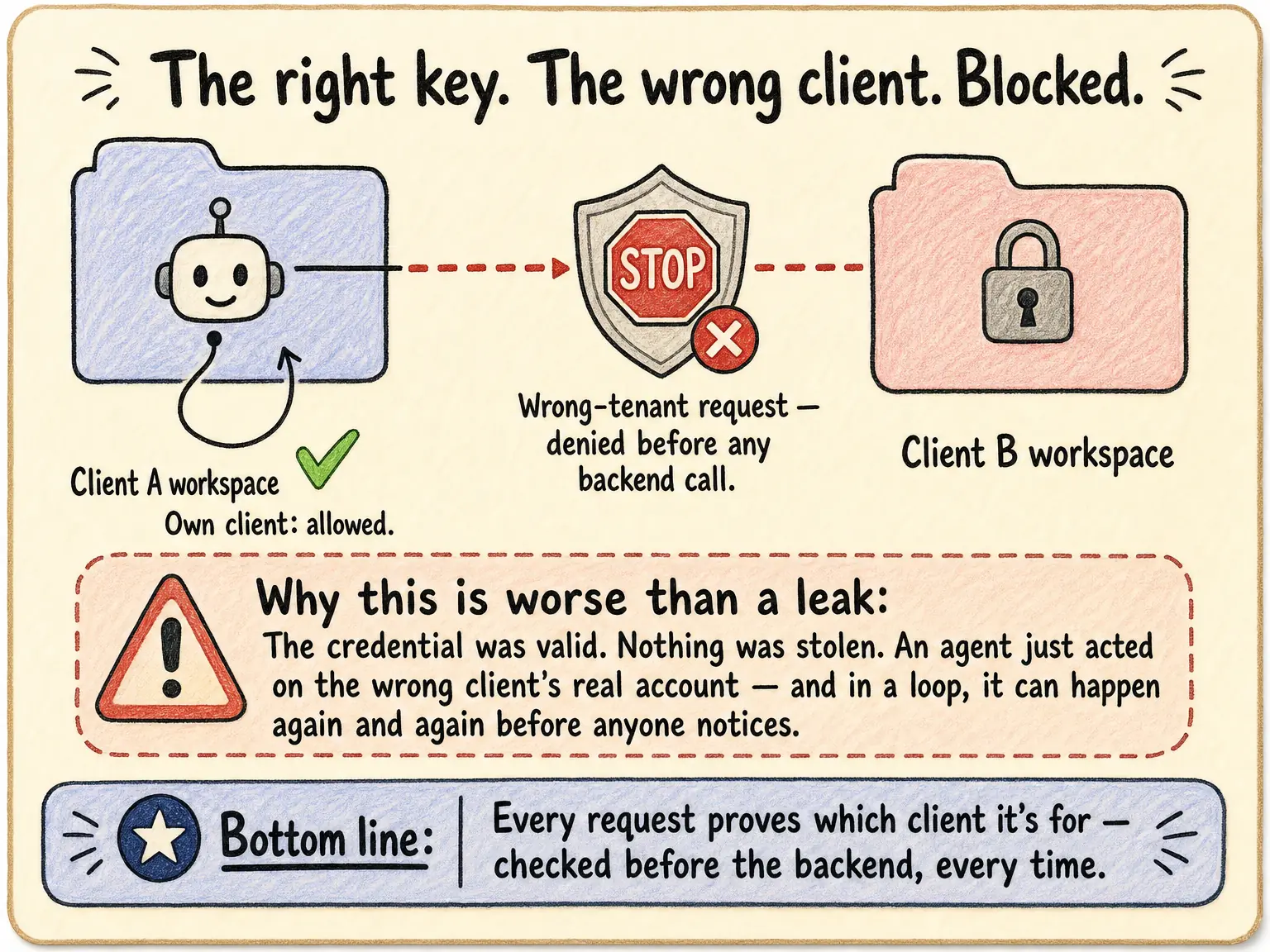
For teams running agents across many clients, this is worse than a leaked key. The credential is real; it is just used in the wrong place. In an unattended loop it can read or write the wrong client's account repeatedly before anyone notices. The fix is tenant-aware routing that blocks the mismatch before any backend call.
The agency problem
When you run agents for many clients, leaking a key is not actually your worst day. Your worst day is an agent doing real work — confidently, autonomously — on the wrong client's account. The credential was valid. The policy was missing.
Client folders are agent environments
A client folder is not just files — it's an agent operating environment with its own instructions, skills, scheduled tasks, and access expectations. When those environments multiply, the boundary between them is exactly what gets blurry. More on multi-client credential sprawl.
Copied skills and shared accounts
Two everyday habits create wrong-client risk: a skill copied from one client that still points at the previous tenant's API, and a shared account used across clients that erases the boundary entirely. Both look harmless until an agent acts on them.
Why loops make it worse
A one-shot prompt makes the wrong-client mistake once. An agent loop makes it repeatedly and unattended — writing to the wrong account again and again before a human is in the room to catch it. The blast radius scales with the loop.
Tenant-aware routing + audit proof
The defense is to make every request prove which client it is for, and to block the mismatch before any backend call — then write what happened to a per-client audit.
Wrong-tenant requests are denied at the policy check
- 01
Agent request
The agent asks for an approved action or alias — not a raw key.
- 02
Policy & tenant check
Outloop checks project, tenant identity, and runtime policy before anything runs.
- 03
Local broker
On approval, the local broker uses the credential on the wire to perform the call.
- 04
Redacted result
The agent receives a sanitized, non-secret result. Raw values never enter its context.
- 05
Audit log
Every attempt is written to a redacted local audit — decision, tenant, service.
The agent never sees the credential. A wrong-tenant request is denied at the policy check, before any backend call.
How Outloop blocks wrong-client access
Outloop checks project and tenant identity at request time. A client-A agent cannot act on client-B credentials: the wrong-tenant request is denied by policy before the backend is ever called, and every attempt is written to a redacted per-client audit. For the full agency picture, see Outloop for AI agencies, or the anonymized call-tracking workflow where this protection runs in practice.
A related but distinct problem shows up when there's only one credential to begin with — an agency-wide login, like a Google Ads manager account, that legitimately reaches every client's account. See workspace-to-resource binding for how a shared credential gets pinned to the one resource each workspace should touch.
Outloop is available with guided onboarding for agency teams; the Mac app is signed with a Developer ID and notarized by Apple, and release v1.1.6 was verified on two Macs on 24 July 2026. See the security model.
Agents should keep working. Humans should stop pasting keys.
Outloop is available with guided onboarding for AI agencies, operators, and dev shops.
Start 14-day trial