Use case · Positioning
Your agency is already the forward-deployed engineer for your clients
Last updated:
In short
A Forward Deployed Engineer bridges general-purpose AI to one organization's specific, messy operational reality — its systems, its data, its approval process.
Most AI marketing and automation agencies already do this for every client they serve. The model, the prompt, the agent framework — that part is a commodity anyone can buy. The differentiated work is connecting it to one client's ad accounts, CRM, Drive, and sign-off process without breaking anything. Agencies just don't call it that yet, and most don't have the access-control layer to do it safely across many clients at once.
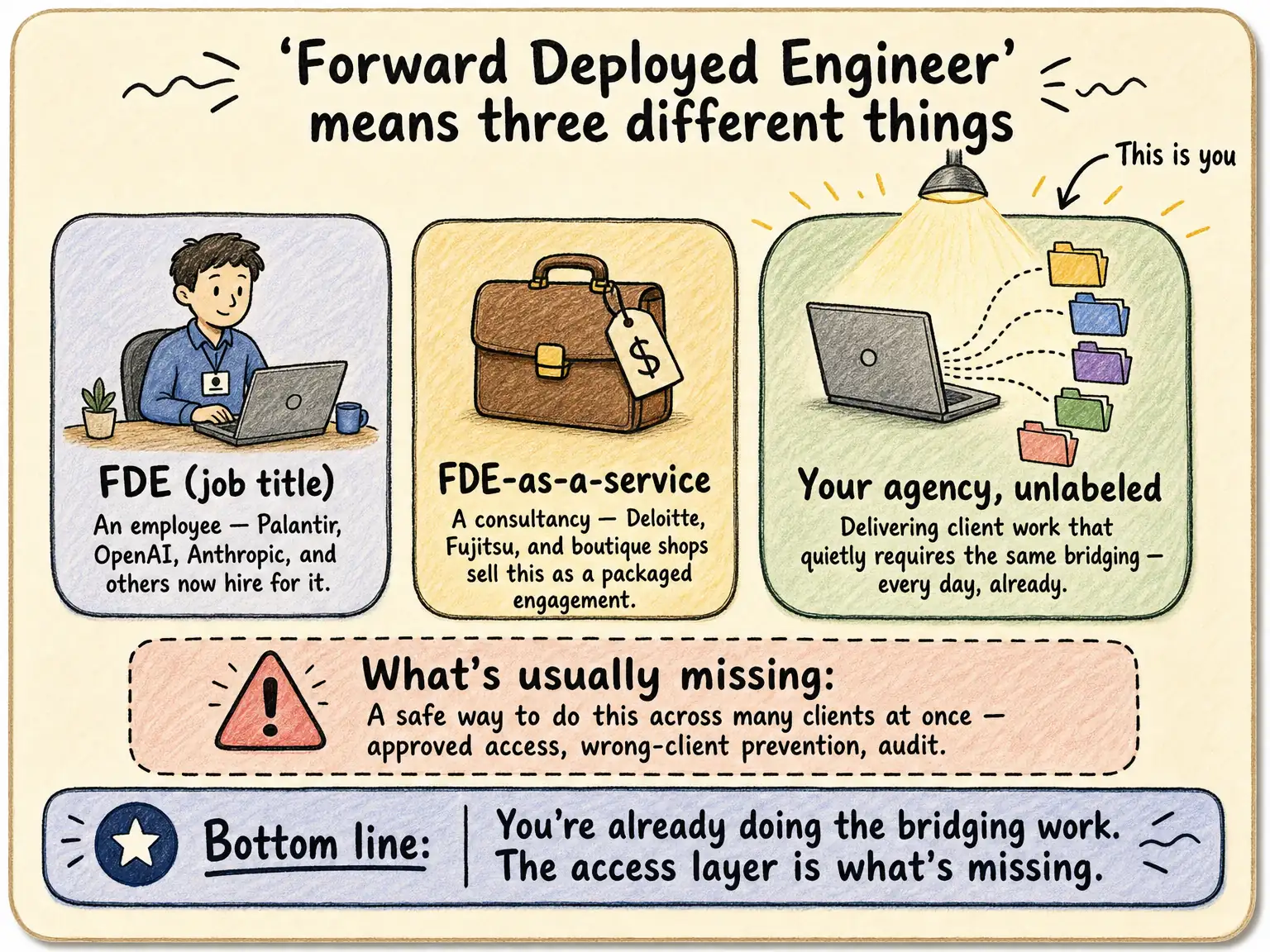
This is not a pitch to become a Forward Deployed Engineer, and Outloop is not an FDE staffing firm or consultancy. It's a reframe: naming a pattern most agencies are already living, and pointing at the one piece of infrastructure that's usually missing.
What a Forward Deployed Engineer actually is
The Forward Deployed Engineer role originated at Palantir, embedding engineers directly inside customer organizations — intelligence agencies, later commercial enterprises — to connect Palantir's software to that customer's real data and workflows, because the customers themselves often couldn't fully specify what they needed. The name borrows from "forward-deployed" military forces: sent to where the problem actually is, not working from a spec written back at headquarters.
The role has since spread. OpenAI and Anthropic both currently list "Forward Deployed Engineer" as an open position — embedding with strategic customers to ship working integrations into their production environments, not just hand over API access and a demo.
The commodity problem
Every business now has access to roughly the same frontier intelligence. That's the reason the FDE pattern exists at all: if everyone is drinking from the same well, the edge moves from who has the model to who can wire it into a specific, real, messy operation. MIT's NANDA initiative put a number on the gap this leaves — in a July 2025 study of roughly 300 enterprise deployments, about 95% of enterprise generative-AI pilots showed no measurable financial impact, mainly because generic tools didn't adapt to the company's actual workflow. The report is preliminary and the "95%" figure has since been overstated in circulation — it describes pilots that didn't integrate deeply, not that AI itself doesn't work. Read narrowly, it's still the right diagnosis: intelligence alone isn't the bottleneck. Integration into one organization's specific reality is.
The reframe: your agency is already doing this
An AI marketing or automation agency doesn't sell a model. It sells the bridge: an agent that actually works inside this client's Google Ads account, this client's CRM, this client's Drive structure, respecting this client's approval process. That is the FDE function, performed continuously, for every client on the roster — usually without the title, and usually without the infrastructure a single embedded FDE would get from their employer.
Our own AI Marketing Agency Operating Playbook lays out the operating discipline this work actually runs on once an agency takes it seriously: a four-stage loop of Propose, Approve, Execute, Audit — the agent proposes an action, a human or policy approves it, the action executes against the real client system, and the result is logged. That loop is the FDE motion in agency practice, whether or not anyone on the team has heard the term.
Three things people conflate
"Forward Deployed Engineer" gets used for at least three different things. Only the third is what most AI agencies actually are.
| Dimension | FDE (job title) | FDE-as-a-service consultancy | Your agency, unlabeled |
|---|---|---|---|
| Who holds it | An employee — Palantir, OpenAI, Anthropic, and others now hire for the title | A firm like Deloitte or Fujitsu, staffed and billed per engagement | You — already embedded with every client you serve |
| What the job actually is | Bridge frontier model behavior into one company's systems and data | Sell that bridging work as a packaged, billable engagement | Deliver marketing or ops workflows that quietly require the same bridging |
| Who owns the client relationship | The employer | The consultancy | You |
| What's usually missing | Nothing — the employer built internal tooling for this | Nothing — the engagement fee covers the tooling | A safe way to do this across many clients at once: approved access, wrong-client prevention, audit |
| Where a runtime access layer fits | — | — | Exactly here |
The gap: doing it safely across many clients at once
A single embedded FDE bridges AI into one organization, with that organization's own security team and tooling behind them. An agency is doing the same bridging work for five, twenty, or a hundred clients simultaneously — and the failure mode is different. It's not "the integration doesn't work." It's an agent using client A's ad account credential for a task that was supposed to touch client B, or a raw key sitting in a project folder an agent can read, log, and accidentally surface. Multiplying the FDE pattern across many clients multiplies that risk unless something explicitly governs which client, which account, and which credential a given action may use.
That's the layer Outloop provides — not FDE staffing or consulting, but the runtime access and policy infrastructure underneath it: credentials stay in the Mac Keychain or another approved backend, agents request approved actions instead of raw secrets, access is scoped to the correct client workspace, wrong-client execution is blocked before any backend call, and every attempt is written to a redacted audit log. See what agent runtime access is and the full picture for AI agencies.
What happens when your agency's agent requests a client's API access
- 01
Agent request
The agent asks for an approved action or alias — not a raw key.
- 02
Policy & tenant check
Outloop checks project, tenant identity, and runtime policy before anything runs.
- 03
Local broker
On approval, the local broker uses the credential on the wire to perform the call.
- 04
Redacted result
The agent receives a sanitized, non-secret result. Raw values never enter its context.
- 05
Audit log
Every attempt is written to a redacted local audit — decision, tenant, service.
The agent never sees the credential. A wrong-tenant request is denied at the policy check, before any backend call.
Sources
Claims verified against these pages on July 21, 2026. The FDE role and the AI-adoption research it draws on are both moving fast — check the primary sources if you're reading this later:
- →Palantir and the origin of the Forward Deployed Engineer model — Pragmatic Engineer
- →OpenAI — Forward Deployed Engineer (FDE), San Francisco (careers page)
- →Anthropic — Forward Deployed Engineer, Applied AI (Greenhouse job posting)
- →MIT NANDA — "The GenAI Divide: State of AI in Business 2025" (July 2025)
- →Why the MIT NANDA "95%" figure is often overstated — Futuriom
Related: Outloop Implementation Partners — a distinct, Outloop-specific program, not FDE staffing — Outloop for AI agencies, the AI Marketing Agency Operating Playbook, GTM engineering across many client environments, managing API keys across many agent workspaces, and wrong-client access in agent loops. Outloop is available with guided onboarding for agency teams; the Mac app is signed with a Developer ID and notarized by Apple, and release v1.1.6 was verified on two Macs on 24 July 2026. Palantir, OpenAI, Anthropic, Deloitte, and Fujitsu are named here only as sourced evidence of how the term is used — Outloop is not affiliated with or endorsed by any of them.
You're doing the bridging work. Let's map where it breaks.
Send one real client workflow. We'll map where access breaks and what should be API, MCP, browser fallback, human approval, or blocked — before you touch a second client.